
Two stories, two languages
Writing novels and graphic novels

Every time someone asks me what the real difference is between writing a novel and writing a graphic novel, my first honest thought is:
How the hell am I supposed to write this?
Not because one is “better” than the other but because they demand two completely different ways of thinking.
I work mainly with fiction and historical fiction. These are the two fields where I have the most experience, and they are also the two fields where the contrast between novel and graphic novel becomes painfully clear.

Writing without images vs writing with them
A novel has no images.
Yes, there are exceptions. Some older editions include illustrations. The Chronicles of Narnia is a good example. I own a special edition of The Lion, the Witch and the Wardrobe precisely because of its illustrations. Another example is Dickens’ A Christmas Carol. I have an edition with reproductions of the original 1843 illustrations, and it’s extraordinary to think that people were producing work like that almost two centuries ago.
But still, the essence of a novel is text. Pure writing.
And that means something very important. The reader is free.
No matter how detailed your descriptions are, the final image never belongs to the writer. It belongs to the reader. The reader decides how a character looks, how a landscape feels, how a city breathes. I’ve read historical novels where entire scenes still exist vividly in my mind, not because of illustrations, but because my imagination was allowed to do the work.
When you write a novel, you must accept this. You must be ready to let go. The reader will always create their own version of your world.
A graphic novel stands on the opposite side.
Here, images are not optional. They are not secondary. They are the story. You don’t just suggest. You show. And once something is shown, it’s fixed. The reader can interpret it, of course, but they cannot reinvent it visually.
This is where the biggest challenge begins.
Writing a graphic novel is never just about writing. It’s about collaboration. You have to work closely with an illustrator or artist and make them understand exactly what you mean or sometimes accept that they will understand it differently. Even if you illustrate your own work (which I personally don’t), the responsibility is the same: you must decide what is visible.
In my graphic novel Nostrandor, there’s a scene where two characters stand on a castle balcony and watch an owl fly away, carrying an important message. In the graphic novel, you simply see the owl disappear at the horizon. The emotion is there but it’s restrained. Minimal. Suggestive.
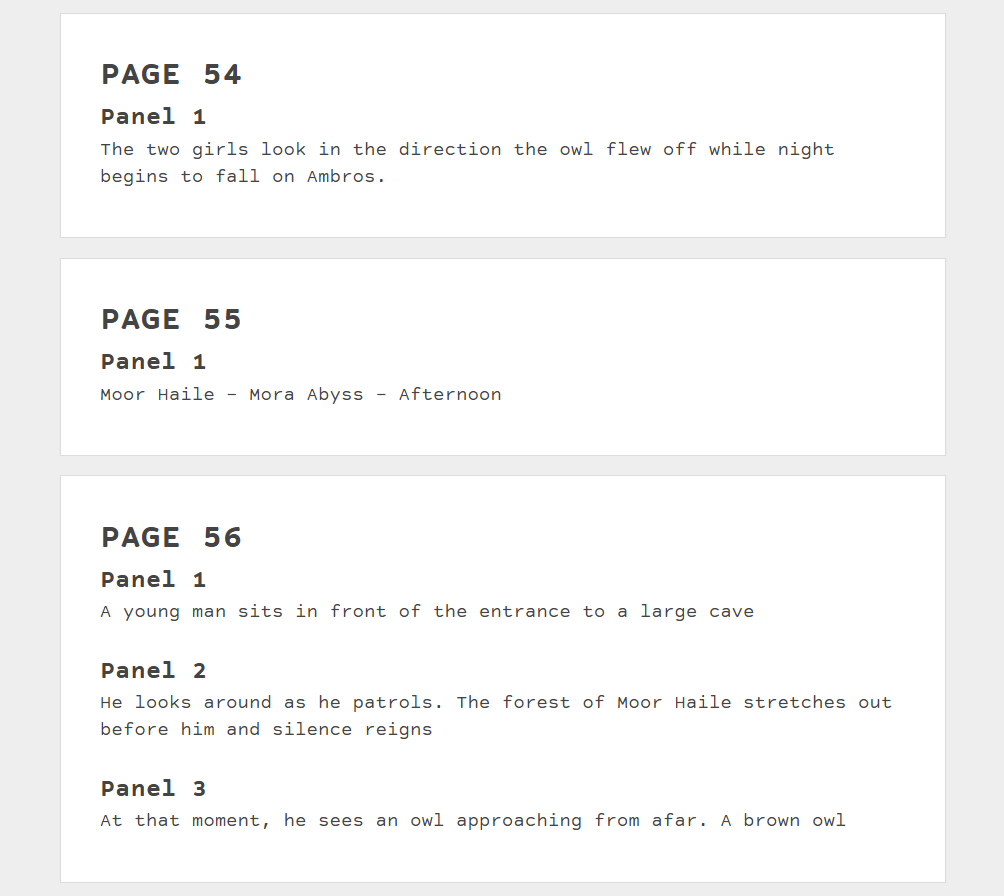
When I rewrote the same scene as a novel, everything expanded. I could describe the sunset, the feathers, the fading light, the transition from day to night and, most importantly, how each character felt about that moment.
That’s the key difference.
A novel builds emotion through accumulation of words.
A graphic novel removes words to make space for images.
Writing the page, not the chapter
From a practical point of view, writing a graphic novel forces you to think structurally in a completely different way.
You don’t think in chapters. You think in pages and panels.
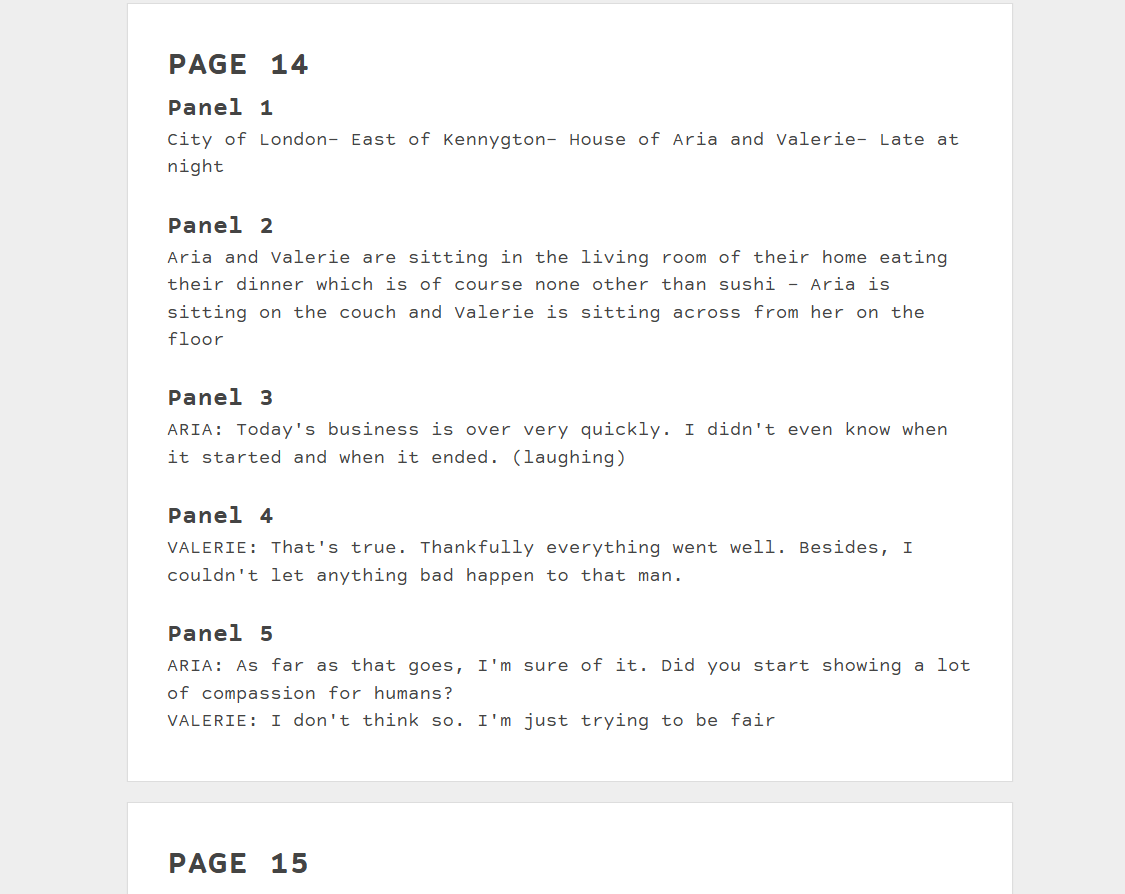
I tried writing graphic novels in simple text documents at first, but it didn’t work for me. I needed to see the page. I needed to separate it visually. Software designed specifically for graphic novels and comics forces you to do that. And that’s a good thing. You must decide whether a page has one panel or many. Whether it slows the reader down or pushes them forward.
In Nostrandor and The Guardians, there are pages with a single panel. Used deliberately to make the reader pause. Other pages are fragmented into multiple panels to create rhythm and movement.
As a novelist, this was extremely difficult at first.
My instinct is to write structure first, as if I’m writing a novel, and only then translate it into images. I usually start with a narrative flow and then ask myself: How would this look on the page? That translation process is hard—and sometimes painful—because you immediately realize how much you must cut.
And this is where another misconception appears.
A graphic novel is not just a comic.
Graphic novels are much larger, much denser, and structurally more demanding. My first volume of Nostrandor was close to 150 pages. Translating a single novel chapter into graphic form can result in 30, 40, or even 50 pages, depending on pacing, imagery, and atmosphere.
That’s why writing a graphic novel is not easier than writing a novel. It’s just difficult in a different way.
But the most important lesson I’ve learned is this:
Not every story wants to be a graphic novel.
Some stories lose their strength when translated into images. I experienced this as a reader. Agatha Christie’s Murder on the Orient Express is a brilliant novel. But as a graphic novel, it didn’t work for me. Too much psychology, too much inner tension, too many layers that depend on prose.
That’s also why I never turned my historical novel The Antimatter into a graphic novel. It relies heavily on inner conflict, memory, and emotion. All those things that don’t compress well into panels and short lines.
So when people ask me about the difference between writing a novel and writing a graphic novel, I don’t give them a technical definition.
I tell them this:
A novel asks: What does this feel like?
A graphic novel asks: What does this look like?
And choosing the wrong form doesn’t just change the story—it can break it entirely.
Till next time, keep remembering—never stop wondering about the past.
➡️If you enjoy exploring the past through stories, games, and historical fiction, subscribe to Think like an Archaeologist to keep learning and dive deeper into the world of historical fiction. If you want to sharpen your craft, explore my writing systems to find the right tools for your project. And if you’re ready to take your own historical fiction or game project even further, the Studio is where we work together one on one.
➡️ If you’d like to support my books, graphic novels, and creative journey directly, you can always find me on Ko-Fi. Every trowel-sized contribution helps me keep building the worlds I write about — buy me a trowel and keep the dig going.