

Somewhere in southeastern Turkey, there is a temple that is older than farming, older than the wheel, older than writing, older than the city. It was built by people who, according to everything we thought we knew about how civilization works, should not have been capable of building it. And then, at some point, its own builders buried it. On purpose. Completely. As if they wanted it gone.
We still don’t know why.
This is Göbekli Tepe, and if you write historical fiction — novels, graphic novels, video games — I think it might be the single most useful archaeological site on Earth for you to know about. Not because it’s exotic set dressing. Because of what it represents: a hole in the record. A place where the accepted story runs out and the guessing begins. Archaeologists have a quiet, slightly uncomfortable term for sites and finds like this: an archaeological anomaly. Something that doesn’t fit the pattern we’ve built our understanding of the past around. And I’d argue that no single site is more responsible for that term existing than this one.
➡️If you want to sharpen your craft, explore my writing systems to find the right tools for your project. And if you’re ready to take your own historical fiction or game project even further, the Studio is where we work together one on one.
➡️ If you’d like to support my books, graphic novels, and creative journey directly, you can always find me on Ko-Fi. Every trowel-sized contribution helps me keep building the worlds I write about.
What Göbekli Tepe actually is
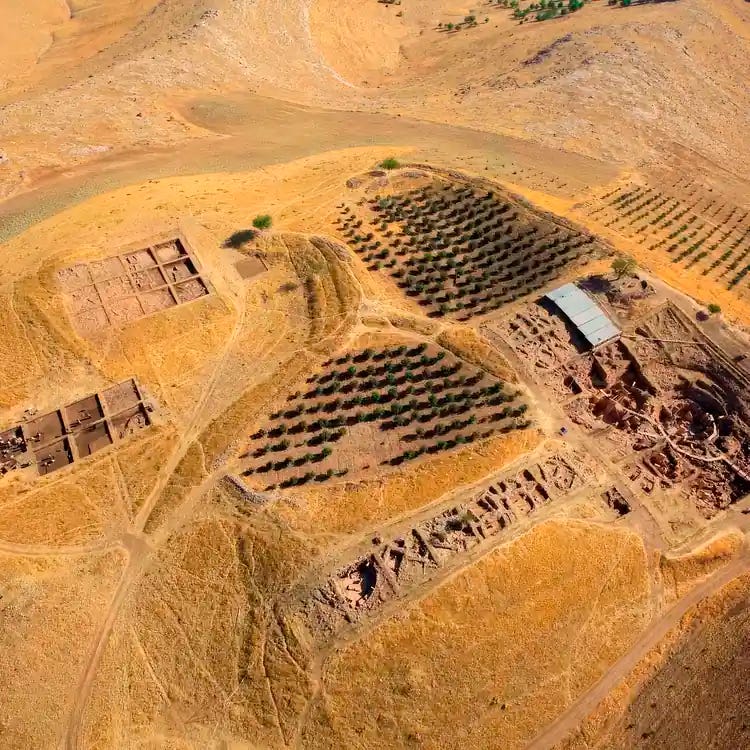
Göbekli Tepe sits in Southeastern Anatolia, not far from the modern city of Şanlıurfa. It was first noticed by a survey team back in 1963, who saw broken slabs poking out of a hillside, assumed they were looking at a medieval cemetery, and moved on. It took until 1994 for German archaeologist Klaus Schmidt to look at the same hill and realize he wasn’t looking at gravestones. He was looking at the tops of enormous carved pillars. Excavation began the following year, and it hasn’t stopped changing the story since.
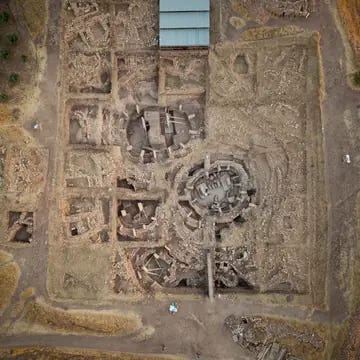
The oldest structures date to around 9600 BCE. That’s roughly six thousand years before Stonehenge. Massive T-shaped limestone pillars, some over five meters tall, arranged in circles up to thirty meters across, many of them carved with intricate reliefs of animals. Foxes, boars, vultures, snakes. And the people who built them were hunter-gatherers. No pottery. No metal tools. No cities. No chiefs that we can identify. No surplus food economy that should have been able to support this kind of coordinated, monumental labor.
And yet, there it is. Still standing. Still carved. Still asking the question.
Why it counts as an anomaly
Here’s the part that actually matters and it’s not the age. It’s the order things happened in.
The conventional story of civilization goes: people learn to farm, farming lets them settle down, settling down builds villages, villages grow into towns, towns eventually build monuments and temples because now they have the spare hands and spare food to do it. Farming first. Monuments last.
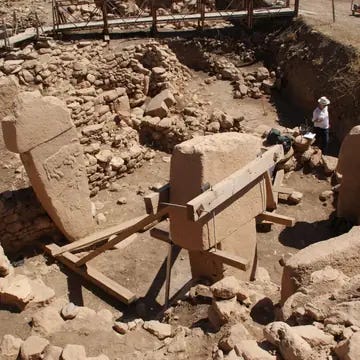
Göbekli Tepe suggests the opposite. There’s no clear evidence of cultivated crops at the earliest phase of the site. Bone fragments show people were still living on wild gazelle and wild wheat. Hunter-gatherer food, in other words, at a site that required settled, organized, sustained labor to build. One foot in the old world. One foot in something entirely new. It’s possible, not proven, but seriously proposed, that people organized around a sacred site before they had agriculture to support permanent settlement. That the need to gather and build might have come before the need to farm, rather than after.
And then there’s the burial. At some point, the people who built Göbekli Tepe chose to fill it in completely. Not abandon it and let time do the work. Deliberately bury it, layer by layer, with the same kind of collective effort it took to raise it. Nobody knows why. A closing ritual? A decommissioning? Fear? Reverence? We genuinely don’t know. Whatever the reason, that same burial is what preserved the site so beautifully for eleven thousand years, which means the very decision that hid it from history is also the reason we get to study it today.
Then there’s the scale of the thing, which is its own kind of evidence. These aren’t a few standing stones. We’re talking about circles up to thirty meters across, pillars weighing tons, carved with careful, repeated animal imagery across dozens of individual stones. That takes more than a few motivated people with free time. It takes planning, coordination, probably some form of shared belief strong enough to pull labor away from the daily work of survival. We tend to assume that kind of organization requires hierarchy. Chiefs, priests, someone giving orders. Göbekli Tepe doesn’t show us any of that. Just the result.
What was it for? Ritual site, proto-temple, gathering place, astronomical marker. All proposed, none confirmed. And that’s not archaeology failing. That’s archaeology being honest. Somewhere around ninety-five percent of everything we’ve excavated from the human past falls into this same category: we have a theory, sometimes a good one, rarely a certainty. Archaeology isn’t a flat encyclopedia of settled facts. It’s an evolving argument, and the ground keeps handing us new pieces that don’t fit the old picture.
Why this is a gift, not a gap
If you write historical fiction, I want you to sit with that uncertainty for a second, because I think most writers instinctively treat it as a liability. Not enough evidence. Not enough sources. Nothing solid to build on.
I’d argue it’s the opposite. An archaeological anomaly like Göbekli Tepe is one of the rare places where the truth itself is doing the work of good fiction for you. This site is real. It existed. People built it with their hands, for reasons we can’t fully reconstruct, and then they walked away from it, or buried it, for reasons we also can’t reconstruct. You don’t have to invent the mystery. You just have to decide how to fill it.
That’s the difference between writing “based on history” and writing into history’s actual unanswered questions. A settlement built around a purpose instead of a harvest. A monument its own builders chose to erase. A civilization doing something civilizations, by our rules, aren’t supposed to be able to do yet. These aren’t plot devices you have to force. They’re already sitting in the record, waiting for someone to give them a reason.
And that’s really the whole point of anomalies like this one. We assume the past is settled because it happened already. But we only ever have the pieces and the pieces keep multiplying faster than our certainty does. Maybe the real anomaly isn’t Göbekli Tepe at all. Maybe it’s how confidently we talk about everything else in the ancient world as if it were solved.
So, have you ever heard the term archaeological anomaly before today?
And if you had a site like Göbekli Tepe to build your next project around, what would you decide happened there?
I’d genuinely love to know. Tell me in the comments.
WOW! And to think there is an idea about hunter-gatherers and "the Great Forgetting" somewhere in my mind brewing. This article is a gift!
What would happened there? Well, maybe it just stood there and become a monument to people? God's Work? Aliens? Titans? Not sure yet.
Fascinating. I just created a lost city for my story, and this gave me a lot to think about. I also read about Mohenja Daro this week in one of Travis Elborough's books. Your articles got me excited about ancient maps and cultures, starting me off on a whole new reading direction. Thank you for that.